

Prooflytics
Marketing Analytics Blog
Benchmarks, attribution frameworks, and platform guides for performance marketers. How to diagnose, decide, and act — without the dashboard fatigue.
- Strategy
Reuters and Time Block AI Crawlers by Default: What the Allowlist Shift Means
Reuters and Time adopted allowlist-by-default AI crawler policies in May 2026, blocking all bots except a pre-approved set. People Inc. expanded its blocked user agents from approximately 2,100 to over 30,000 after the switch. A Tollbit report found 30% of total AI bot scrapes did not comply with explicit robots.txt permissions. Here is how the publisher AI blocking trend affects content strategy and AI visibility.
9 min read - Strategy
CMO vs CIO: The $40B AI Agent Accountability Gap in Enterprise Marketing
AI agent activity increased 150% month-over-month from November 2025 to March 2026. 88% of search visits are now AI agents. A survey of 1,000 enterprise leaders found 75% lack a documented plan and 72% report marketing owns AI agent responsibility without ever being formally handed it. The $40B opportunity at stake requires resolving who owns what between the CMO and CIO.
10 min read - Strategy
The AI Convergence Problem: Why Marketing Is Starting to Sound the Same
A Columbia and MIT study named it the Basic Effect: LLM agents shift people's choices toward more popular options, reducing behavioral distinctiveness. A Science Advances study found generative AI enhances individual creativity but reduces collective diversity. When every team uses the same tools on the same inputs, outputs converge. Here is what that means for brand strategy and where the asymmetric inputs come from.
9 min read - Strategy
How to Measure AI Search Impact on Marketing KPIs
AI search disrupts click-based traffic measurement but does not make marketing performance unmeasurable. Three approaches work in 2026: AI Visibility Tracking (citations and brand mentions in AI outputs), KPI replacement for click-based metrics, and revenue connection via incrementality testing. Here is how to implement each.
9 min read - Strategy
How AI Forms Brand Opinions: The UCD Framework Explained
AI systems form brand opinions from five distinct data streams. One of them (OPID: reviews, support transcripts, case studies, methodologies) carries disproportionate weight. Here is the UCD framework for Understandability, Credibility, and Deliverability, and what it means for how your brand appears in ChatGPT, Perplexity, and Google AI Overviews.
9 min read - Strategy
LinkedIn Content and AI Search Citations: What 325,000 Prompts Show
LinkedIn is the second-most cited domain in AI search results, just behind Reddit. Semrush studied 325,000 prompts and 89,000 LinkedIn URLs. Company pages drive 59% of citations in Perplexity. Individual creators drive 59% of citations in ChatGPT and Google AI Mode. Structure and posting frequency matter more than likes.
8 min read - Strategy
GDPR and Customer Match: What the €1.85M Elkjop Fine Means for Google Ads
Norway's DPA fined Elkjop €1.85M in June 2026 for four violations: bundled consent for loyalty data, Customer Match upload without a compatibility assessment, insufficient legitimate interest documentation for offline conversions, and systematic data subject rights delays. Here is what each violation means for Google Ads teams using Customer Match and offline conversion imports.
9 min read - Strategy
2026 ABM Benchmark: What 84% of B2B Revenue Teams Are Actually Doing
The 2026 ABM Benchmark Survey finds that 84% of B2B organizations use account-based marketing to drive revenue, with 56% focused on new account acquisition and 47% integrating ABM directly with demand generation. Here is what the data reveals about how B2B growth teams are structuring their programs.
9 min read - Strategy
AI Visibility in 2026: Why Transactions Are the New Citations
Late June 2026, Chrome auto-browse rolls out to 200 million Android devices. AI visibility is no longer about whether your site gets cited in ChatGPT or Perplexity. It is about whether an agent can complete a booking or purchase on your site without human help. Eight specific failure modes will silently block those transactions.
8 min read - Strategy
Stop Using Fixed PPC Budget Ratios: How to Allocate by Funnel Health
Fixed 40/60 or 70/30 upper-to-lower funnel budget splits rarely survive real market conditions. Upper-funnel Demand Gen spend takes 4-8 weeks to appear as lower-funnel Search conversions. Here is a conditions-based framework for monthly budget reallocation using Search Terms, impression share, and conversion data you already have.
8 min read 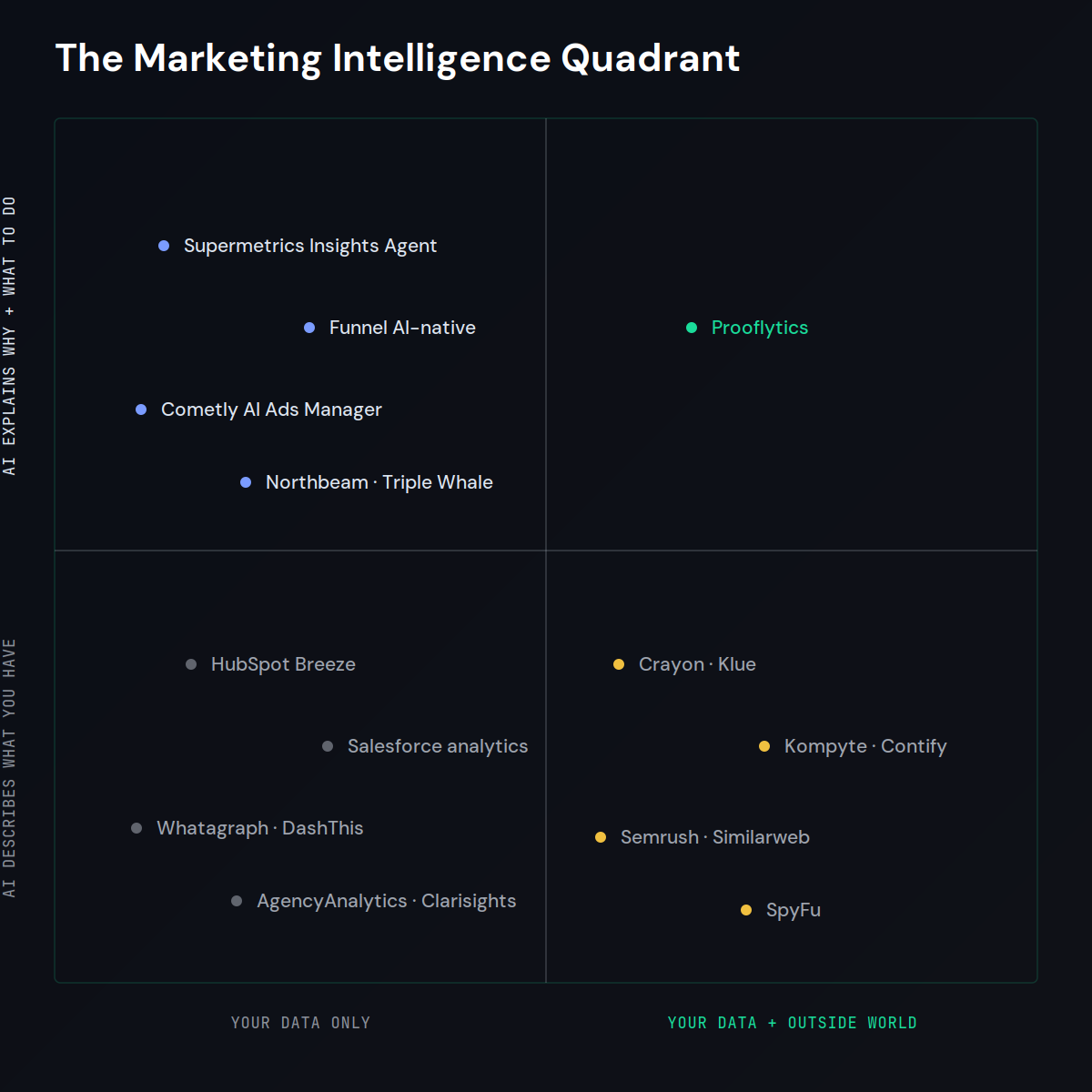 Strategy
The Empty Quadrant: Why Marketing Intelligence Is Not a Better Supermetrics
Every marketing analytics platform now has AI that explains your data. Supermetrics, Funnel, Northbeam -- they reason over your numbers properly now. The problem is they all reason from inside your account. The cause of your CPL moving last Tuesday almost never lives there.
5 min read- Strategy
Why High-ROAS Campaigns Do Not Always Deserve More Budget
The instinct to scale your best-performing campaigns by ROAS is almost universal — and often wrong. High ROAS can signal a saturated audience, a shrinking market, or budget cannibalization from a campaign that should get less money, not more.
8 min read - Strategy
The 'We Need More Data' Delusion in Marketing Analytics
Teams that say 'we need more data' before deciding are usually deferring a decision they already have enough data to make. Analysis paralysis costs 34% slipped deals and 20% longer sales cycles. The framework for deciding when more data actually helps and when it is procrastination.
10 min read - Strategy
The More-Channels-More-Pipeline Fallacy in B2B SaaS
B2B SaaS teams add channels to scale pipeline. Each new channel produces lower marginal returns than the last. 6-month median outcome: 3x channels, 1.2x pipeline, 2.5x operational overhead. Why channel proliferation fails and the concentration alternative.
9 min read - Strategy
The Discount Dependency Death Spiral in DTC (and How to Exit)
Every promotional discount comes directly off gross margin. A 20% sitewide sale on 50% margin product halves order profitability. Why DTC brands get trapped, the math behind margin erosion, and the 90-day exit playbook.
10 min read - Strategy
Marketing Budget Planning Template (2026): 70/20/10 Model + Quarterly Cadence
A marketing budget template needs five sections: total budget sizing, channel allocation (70/20/10 model), quarterly pacing, contingency planning, performance reallocation rules. Copy-ready structure with benchmark spend ranges by ARR stage.
10 min read - Strategy
Marketing QBR Template (2026): Quarterly Business Review for Marketing Teams
A marketing QBR needs 7 sections: prior-quarter results, channel performance, funnel health, unit economics, strategic learnings, next-quarter plan, asks. Copy-ready 60-minute agenda with field-level guidance.
10 min read - Strategy
CMO Board Report Template (2026): 5 Slides That Earn Trust
A CMO board report fits on 5 slides plus appendix: portfolio scorecard, channel efficiency, marketing's revenue contribution, pipeline health, next-quarter plan. The structure that holds up under board scrutiny and gets re-approved each cycle.
9 min read - Strategy
Marketing OKRs Template (2026): Quarterly Goals That Drive Pipeline
Marketing OKRs need 3-5 objectives with 3-5 key results each. Copy-ready quarterly examples for B2B SaaS and DTC, with the structure that ties marketing work to revenue outcomes (not vanity metrics).
10 min read - Strategy
Marketing KPI Tree Template (2026): From North Star to Owned Metrics
A marketing KPI tree connects one north-star metric to 3-5 driver metrics, then to 2-3 owned metrics per driver. Copy-ready structure for B2B SaaS and DTC with named owners and the 60-minute build workflow.
10 min read